Compliance helpers
Educational. A score, a card or a checklist on this site is not a determination that a job is compliant.
Interactive pre-start checklist
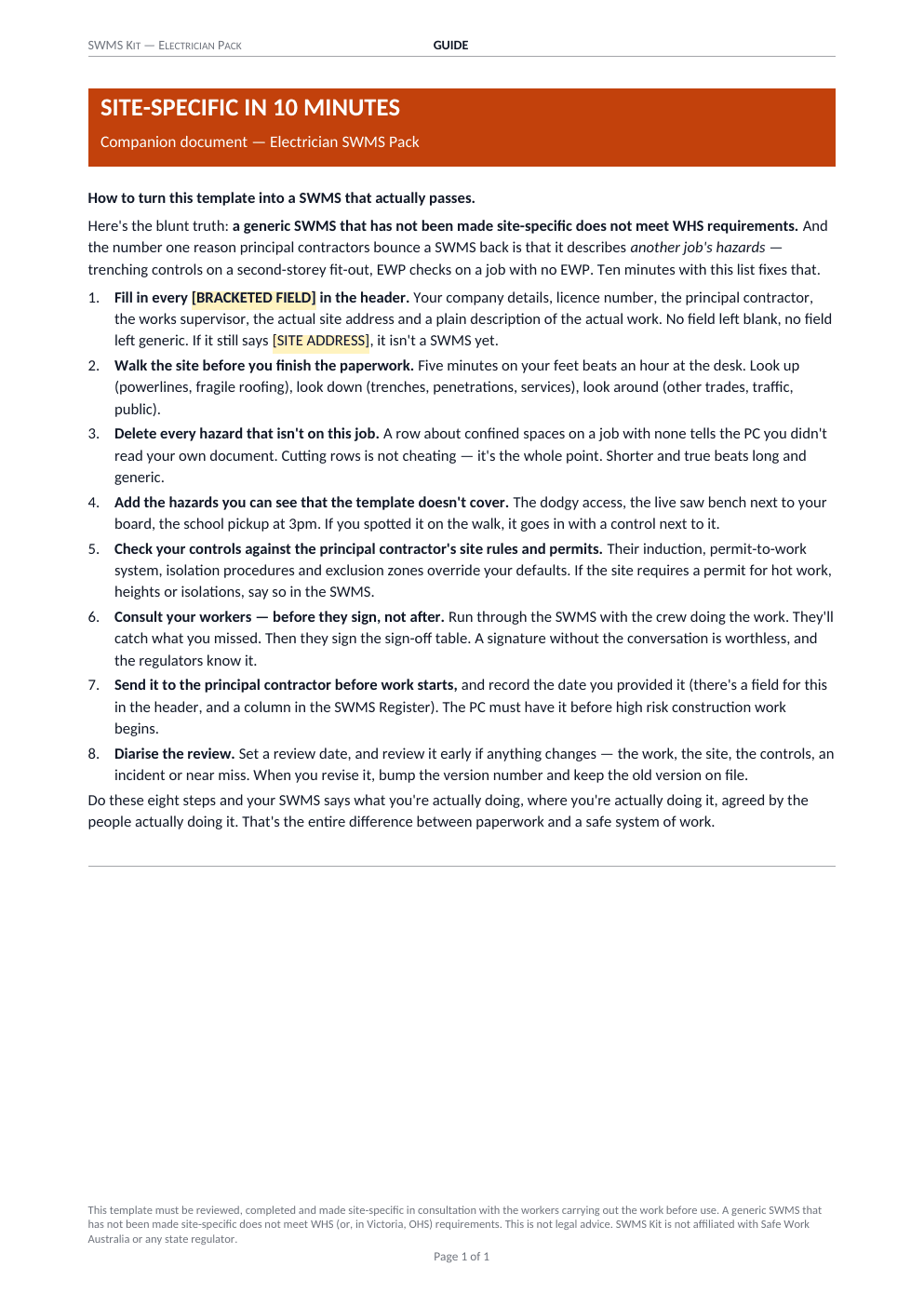
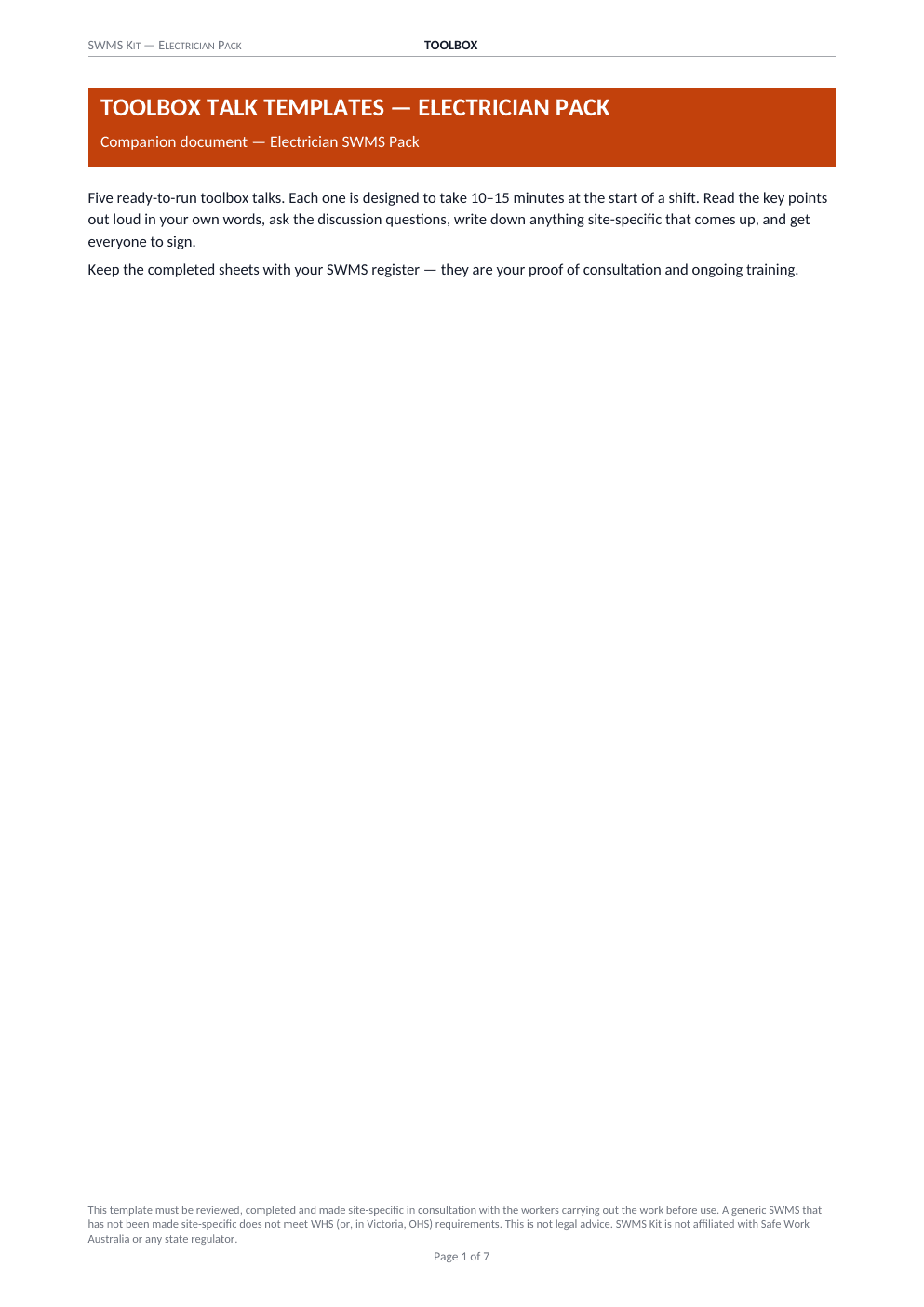
Which file to open
- New South Wales
Model WHS version · SafeWork NSW
Work Health and Safety Regulation 2025 (NSW), in force from 22 August 2025, when it replaced the 2017 regulation. Section 291 is the 18 model categories, including a fall of more than 2 m. On construction projects worth $250,000 or more, give the SWMS to the principal contractor before the work starts. SafeWork NSW publishes Form 05 as a SWMS template.
- Queensland
Model WHS version · WorkSafe Queensland
Work Health and Safety Regulation 2011 (Qld). Sections 299–303 put a penalty on each SWMS duty. Failing to prepare a SWMS is 60 penalty units. The penalty unit for the Work Health and Safety Act 2011 is $100, so that maximum is $6,000. The general Queensland penalty unit of $172.70 from 1 July 2026 is a different rate. A construction project is work costing $250,000 or more.
- Victoria
Victorian OHS version · WorkSafe Victoria
Victoria never adopted the model WHS laws. Use the Victorian OHS version: 19 high risk construction work categories, employer / self-employed wording (not PCBU), and consultation with affected employees and their HSRs.
- South Australia
Model WHS version · SafeWork SA
Work Health and Safety Regulations 2012 (SA). From 1 July 2026 a risk of falling more than 2 metres is high risk construction work (it was 3 metres). A construction project, which is when a principal contractor is required, is work costing $450,000 or more — not the model $250,000.
- Tasmania
Model WHS version · WorkSafe Tasmania
Work Health and Safety Regulations 2022 (Tas). Regulation 291 matches the model, including a fall of more than 2 metres, and a construction project is work costing $250,000 or more. Use the Model WHS version.
- Australian Capital Territory
Model WHS version · WorkSafe ACT
Work Health and Safety Regulation 2011 (ACT). Section 291 follows the model and adds processing crystalline silica material with a power tool or another mechanical method. A construction project is work costing $250,000 or more, or demolition or refurbishment of a structure containing loose-fill asbestos insulation.
- Northern Territory
Model WHS version · NT WorkSafe
Work Health and Safety (National Uniform Legislation) Regulations 2011 (NT). From 17 July 2026, residential construction (a Class 1 building, or a Class 10 building attached or adjacent to it) is high risk construction work for a fall of more than 3 metres. Other construction stays at more than 2 metres. From 28 May 2026 a construction project is work costing $1,000,000 or more. Record heat on the SWMS when it changes the controls, especially ceiling and roof work.
- Western Australia
Model WHS version · WorkSafe WA
Work Health and Safety (General) Regulations 2022 (WA). Regulation 291 matches the model 18 categories, including a fall of more than 2 metres, and regulations 299–303 are the SWMS duties. A construction project is where 5 or more persons are, or are likely to be, working at the same time — not the model $250,000 test. Use the Model WHS version, not the Victorian one.
Model law — 18 categories
- a. involves a risk of a person falling more than 2 m (SA: 2 m from 1 July 2026 — previously 3 m)
- b. is carried out on a telecommunication tower
- c. involves demolition of a load-bearing element of a structure
- d. involves, or is likely to involve, disturbing asbestos
- e. involves structural alterations or repairs requiring temporary support to prevent collapse
- f. is carried out in or near a confined space
- g. is carried out in or near a shaft or trench deeper than 1.5 m, or a tunnel
- h. involves the use of explosives
- i. is carried out on or near pressurised gas distribution mains or piping
- j. is carried out on or near chemical, fuel or refrigerant lines
- k. is carried out on or near energised electrical installations or services
- l. is carried out in an area that may have a contaminated or flammable atmosphere
- m. involves tilt-up or precast concrete
- n. is carried out on, in or adjacent to a road, railway, shipping lane or other traffic corridor in use by traffic other than pedestrians
- o. is carried out in an area with movement of powered mobile plant
- p. is carried out in an area with artificial extremes of temperature
- q. is carried out in or near water or other liquid with a risk of drowning
- r. involves diving work
Victoria — 19 categories
- 1. where there is a risk of a person falling more than 2 m
- 2. on or next to roadways or railways used by road or rail traffic
- 3. in, over or next to water or liquids where there is a risk of drowning
- 4. at workplaces where there is any movement of powered mobile plant
- 5. where structural alterations require temporary support to prevent collapse
- 6. in an area with artificial extremes of temperature
- 7. on or near energised electrical installations or services
- 8. involving a trench or shaft more than 1.5 m deep
- 9. on or near pressurised gas distribution mains or piping
- 10. involving demolition
- 11. involving a confined space
- 12. on or near chemical, fuel or refrigerant lines
- 13. involving tilt-up or precast concrete
- 14. on telecommunications towers
- 15. involving diving
- 16. involving removal or disturbance of asbestos
- 17. in an area that may have a contaminated or flammable atmosphere
- 18. involving the use of explosives
- 19. involving a tunnel